Showing posts with label Travelogue. Show all posts

Sunday, August 28, 2022

Threads of Awakening

Blurb:

What if you set out to travel the world and got sidetracked in a Himalayan sewing workshop? What if that sidetrack turned out to be your life's path--your way home?
Part art book, part memoir, part spiritual travelogue, Threads of Awakening is a delightful and inspiring blend of adventure and introspection. Leslie Rinchen-Wongmo shares her experience as a California woman traveling to the seat of the Tibetan government-in-exile in India to manage an economic development fund, only to wind up sewing pictures of Buddha instead. Through her remarkable journey, she discovered that a path is made by walking it--and that some of the best paths are made by walking off course.
For over 500 years, Tibetans have been creating sacred images from pieces of silk. Much rarer than paintings and sculptures, these stitched fabric thangkas are among Tibet's finest artworks. Leslie studied this little-known textile art with two of its brightest living masters and let herself discover where curiosity and devotion can lead. In this book, she reveals the unique stitches of an ancient needlework tradition, introduces the Buddhist deities it depicts, and shares insights into the compassion, interdependence, and possibility they embody.
 
Thoughts:

A travelogue/memoir, this turned out to be an informative as well as an enjoyable read. Rinchen-Wongmo describes her journey to learn the art of Tibetan fabric thangkas. Her interest in it began on a visit to Dharamsala, India, the seat of the Tibetan government-in-exile.
Although the book is largely on this rare textile art, it has a lot of Buddhist philosophy and ritual practices. This is natural as the art form usually depicts a Buddhist deity, scene, or mandala. Rinchen-Wongmo explains it all in a simple, interesting manner.
I liked its structure. Like the fabric thangkas the author creates, 58 chapters are each labelled a 'piece'. They are grouped into seven parts with titles, such as fibers, threads, warp, weft, etc. It makes for a nice flow that weaves her experiences into a unique story.
Rinchen-Wongmo has managed to include the basics of geography and history necessary to make the audience aware of the significance of the subject matter. A detailed appendix about the process of making thangkas is given at the end of the book. There is also a glossary of words with Tibetan, Sanskrit, and Hindi origins.
Given that the content mainly refers to Tibetan sacred icons it must have been difficult to maintain a fine balance between being respectful and engaging. Her writing style is both.
I would recommend it to anyone interested in textile art, crafts, Buddhism, and accounts of people pursuing lives off the beaten path.

Note: BookSirens gave me a free copy of this book in exchange for an honest review.

Wednesday, June 22, 2022

The Backpack Years

Blurb:
Part travel, part romance, part failing at life, The Backpack Years intertwines two memoirs, charting Stef and James’s six-year journey from happily wandering to miserably settled and back again.
Straight-laced Stef left America to study abroad in Spain, letting loose and falling head over heels for two things: a handsome local and travel. Travel won out. James had a future in England he felt he’d already destroyed. Fueled by debt and a deteriorating relationship with his father, James fled to Australia and found something better.
After language mishaps in France and a topless night in Tenerife, an awful offal job in Warrnambool and a kidnapped manicure in Bali, Stef and James meet at an Irish pub in Sydney. Though their adventures are pulling them in different directions, they ditch the single life to forge a path together.
Can the two navigate their way through red-tape, relocation, miscommunication, and a last ditch, make-or-break trip to try to save their relationship, or will this be their last adventure as a couple?
Spanning thirteen countries and four continents, The Backpack Years is a story about how far we’re willing to go to be with the one we love.

Thoughts:

Exactly as the blurb says, the book contains the memoirs of Stef and James—their separate perspectives on travel, romance, and life—that blend into one story.
It starts in 2000, spanning their travel through thirteen countries and four continents. Initially, they travel solo but meet a third of the way through the book. They change their plans so that they can travel and stay together.
This leads to a whirlwind marriage and many obstacles that prevent them from traveling for some time. When their relationship is threatened, they seek to remedy it with another trip.
Although the book has been co-written by two people with different viewpoints, it is easy to read because the change of narrator is clear. The writing is vivid, engaging, and immersive.
The authors have written quite candidly about their lives. They are honest about the great and not-so-great parts of their relationship and lifestyle. World travel, especially as backpackers, can involve budgetary restraints, illnesses, and dangers related to regional issues.
When I started reading it, the descriptions of their conditions—lack of money; sparse hygiene; abundance of sex, alcohol, and drugs; troubles with work/visa/permits; and adjusting to cultural differences—appalled me.
However, Stef and James managed to handle all that because they were resilient and had ample support from the great friends they made along the way. The Backpack Years shows how far Stef and James were willing to go to save their relationship and follow their dreams.
It is a balanced account of how challenging and rewarding travel and making a relationship work can be. Despite my initial misgivings, I found it enjoyable.
Note: I received an advance review copy from BookSirens in exchange for an honest review.

Saturday, April 23, 2022

Road to Mekong


Blurb:

For fifty-six days, four women left their ‘regular lives’, homes, families and comfort, to ride their motorbikes through scenic landscapes, inhospitable terrain and diverse regions. In this process, they covered 17,000 kilometres through six countries. What inspired them to follow this dangerous, and at times maddening, adventure trail?

In Road to Mekong, Piya Bahadur recounts her once-in-a-lifetime journey through Southeast Asia. With little prior experience in expeditions of this nature, the group successfully planned and executed an exhilarating trip from Hyderabad, through the east Indian coast and the northeast of India, weaving through Myanmar, Thailand, Laos and Vietnam, along the river Mekong, and finally to Cambodia. By the time they returned, the lives of these audacious women had changed forever.

Piya takes the reader along on her travels through places rarely visited by the itinerant Indian and shares the new world that unfolds as she journeys from being a working mother constrained by her own inhibitions to a confident traveller accepting of whatever adventures life has to offer.

Thoughts:

I bought the book because its cover and blurb seemed quite interesting. I wanted to know more about these four women who went on a bike ride through six countries covering 17,000 kilometres.

The journey was sometimes arduous because of the red tape involved and also because of the vagaries of the route. They were able to overcome everything because they were strong, courageous, and determined. The joy of experiencing new places and diverse cultures was enough compensation for them. They also had the support of a team that followed them in a bus. 

The book is a good choice for those who love travel, women empowerment, chasing dreams, and breaking norms. The descriptions are vivid, the narrative interesting, and the language, simple and apt. Bahadur has explained the process of planning and executing the long ride quite well.

However, you would be disappointed if you wish to know more about the camaraderie between the four women, the personal challenges they overcame, or the friendship they forged. Bahadur does not dwell too much on the personal or the human aspect, except if it was directly related to their trip.

You will understand more about why this is so and what they wanted to accomplish with this journey when you read the last two chapters.

Overall, a good book!

Friday, December 10, 2021

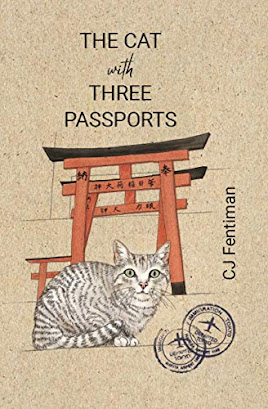
The Cat with Three Passports


Blurb:

A girl struggling to fit in. A homeless kitten. An unexpected job offer in an unfamiliar country that changes everything.
C.J. Fentiman had a long history of escaping places and people she wasn't fond of. But for the sake of a silver tabby, she decided to stay in Japan for a while. This decision helped her open up her heart and mind, revisit her way of thinking, and reconnect with her estranged family.
Let this heartwarming memoir take you to the land of cats and cherry trees as you read about CJ's adventures - from the craziness of Furukawa's naked men festival, the experience of forest bathing and the significance of finding a life purpose or ikigai, to the temples of Takayama, and wonders of Cat Island - you'll see what a homeless kitten found outside a temple in Japan taught her about an old culture and new beginnings.

Thoughts:

Negatives
  • I dislike people using their initials as their first names.
  • The title The Cat With Three Passports was misleading: 
    • The cat Gershwin with the passports does not feature in the book as much as I expected.
    • He did not travel to three countries but stayed in Japan throughout the book. He was expected to leave for the UK with the author but she changed her mind and moved to Australia with him in the end.
  • The author refers to her oldest friend Karina, with whom she visited Cat Island, as ‘Karen’. Was this a typo or a mistake? Why wasn’t this caught by the editor?
Positives
  • The author and her partner Ryan travel to Japan to take up teaching jobs. They are entrusted with looking after two cats by their predecessors in those jobs. They also take in a stray cat and name him Gershwin.
  • The book refers to some difficult times in CJ's life but it is a comfortable and easy read. The writing style is frank and upbeat.
  • You get to see how the author’s experiences in Japan and her interactions with the people she meets there—both Japanese and expatriates—bring about a positive change in her outlook towards life.
  • The book has a lot of interesting tidbits about living, working, and traveling in Japan. It would be of great help to anyone thinking of visiting Japan.
  • Each chapter starts with a Japanese saying about cats. I loved this (I am a typical cat person). 

To summarize, a heart-warming, entertaining book despite the negatives.

Note: I received an advance review copy from BookSirens for free, and I am leaving this review voluntarily.

Saturday, April 10, 2021

Off the Beaten Track across Ecuador, Peru and Bolivia


Blurb:
Three things happened simultaneously. The lioness charged, Alistair fled across the parched savannah and his wife screamed for him to run faster. Stuffed deep inside his tattered rucksack was a guidebook containing advice on what to do in wildlife emergencies, which he planned to read if he survived the next thirty seconds. Future plans to climb Kilimanjaro, teach English in the Amazon and live in Australia were temporarily forgotten as he turned to face the pouncing lioness, thinking back to the words of advice from his mother-in-law. "Don't do anything silly, and look after Francine." From deep underground in a remote Bolivian mine to the scorched Australian outback, this is an adventure travel story. It explores the turbulence of redundancy, the excitement of travel, the anguish of leaving home and the challenges of starting a new life in Australia.

Thoughts:
When his factory job in Luton with Vauxhall ended unexpectedly, Alistair McGuinness uses his final pay check to travel to South America with his wife Francine.
Francine is cautious, adapts to situations easily, and gets by with the smattering of Spanish she manages to learn. The same cannot be said for Alistair who does not learn Spanish, eats without caution and invariably falls ill, and is extremely gullible.
Together, they land in a lot of trouble mainly because of making impromptu decisions, not preparing in advance, and their trusting nature. However, they manage to have an extraordinary adventure and wriggle out of all troublesome situations.
I am not much of a traveller. On the rare occasions that I do travel, I prepare for all contingencies. So, it was very interesting to read about the exploits of spontaneous travellers, such as the McGuinnesses.
I like the way Alistair has managed to write about geography, history, and everyday occurrences, without taking away from any of these. His sense of humour is quite evident from his writing, which is easy to read, keeps you engaged, and makes you feel as though you are travelling with him. To sum up, this is a refreshing, delightful, enjoyable, well-written travelogue, with a bonus of quirky photographs, such as that of a donkey named Angus.

Note: I received an advance review copy for free from BookSirens.