Showing posts with label Japan. Show all posts

Wednesday, January 25, 2023

The Cat Who Saved Books


Blurb:

A celebration of books, cats, and the people who love them, infused with the heart-warming spirit of The Guest Cat and The Travelling Cat Chronicles.
Bookish high school student Rintaro Natsuki is about to close the second-hand bookstore he inherited from his beloved bookworm grandfather. Then, a talking cat named Tiger appears with an unusual request. The feline asks for—or rather, demands—the teenager’s help in saving books with him. The world is full of lonely books left unread and unloved, and Tiger and Rintaro must liberate them from their neglectful owners.
Their mission sends this odd couple on an amazing journey, where they enter different mazes to set books free. Through their travels, Tiger and Rintaro meet a man who leaves his books to perish on a bookshelf, an unwitting book torturer who cuts the pages of books into snippets to help people speed read, and a publishing drone who only wants to create bestsellers. Their adventures culminate in one final, unforgettable challenge—the last maze that awaits leads Rintaro down a realm only the bravest dare enter...

Thoughts:

Rintaro Natsuki, the 17-year-old protagonist of The Cat Who Saved Books, inherits a bookshop when his grandfather dies. He is preparing to close it up and go live with an aunt when Tiger, a talking ginger tabby cat, appears in the shop and demands that he help it save books.
Tiger takes him inside four labyrinths filled with books. Sayo, Rintaro's classmate who visits him frequently, also accompanies them from the second trip onwards.
In the four mazes, they meet people who the author, Sōsuke Natsukawa, represents as people who misuse, mistreat, or misunderstand books:
  • The first person is only interested in the number of books he reads. He wants to read the most books possible in his lifetime; he no longer derives any pleasure from reading.
  • The second one thinks that the only way to keep people interested in reading is to shorten/summarize or cut books.
  • The third does not care for great books—he is interested only in popular books, meaning those that sell well.
  • The fourth person, one whom Tiger calls the most dangerous, makes Rintaro question the meaning/purpose of literature and books.
If you love books and agree with the author's opinions, you may enjoy this. I did, especially because I love cats and books. However, it left me wondering about many things:
  • Why are the characteristics of Rintaro, Sayo, and Tiger described repeatedly?
  • Where did Tiger come from? What does it represent/symbolize?
  • The title says the cat who saved books. Then why is Tiger only taking Rintaro to places where books are being mistreated and Rintaro doing the actual saving?
  • Are the villains actually evil or just representatives of the changing times?
  • Are classics disappearing? Aren't they more accessible these days? Does everyone who loves books need to read classics? If readers find them difficult, isn't it all right if they read condensed versions or summaries?
  • Don't readers' tastes or neurodivergence count?
  • The grandfather, the bookshop owner who left it to Rintaro, was a former university professor. He has supposedly imparted a lot of wisdom, especially about the 'power of books'. However, that is not clearly explained in the book.
  • How will Rintaro, a high school student, manage to run the shop?
That said, the book emphasizes the general importance of books and the joy of reading. It talks about books making you aware of other people and places and helping develop compassion, tolerance, and empathy.
Rintaro tells Sayo that if you find a book difficult, it's because it contains something new to you and that it offers you a challenge. This is true not just of books but a lot of the things you encounter in life.
I can't comment on the translation by Louise Heal Kawai. I liked her note about the hows and whys of it at the end of the book. 
To summarize, a simple story with a touch of magical realism that makes you think.

Friday, December 10, 2021

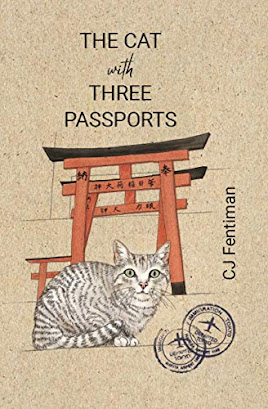
The Cat with Three Passports


Blurb:

A girl struggling to fit in. A homeless kitten. An unexpected job offer in an unfamiliar country that changes everything.
C.J. Fentiman had a long history of escaping places and people she wasn't fond of. But for the sake of a silver tabby, she decided to stay in Japan for a while. This decision helped her open up her heart and mind, revisit her way of thinking, and reconnect with her estranged family.
Let this heartwarming memoir take you to the land of cats and cherry trees as you read about CJ's adventures - from the craziness of Furukawa's naked men festival, the experience of forest bathing and the significance of finding a life purpose or ikigai, to the temples of Takayama, and wonders of Cat Island - you'll see what a homeless kitten found outside a temple in Japan taught her about an old culture and new beginnings.

Thoughts:

Negatives
  • I dislike people using their initials as their first names.
  • The title The Cat With Three Passports was misleading: 
    • The cat Gershwin with the passports does not feature in the book as much as I expected.
    • He did not travel to three countries but stayed in Japan throughout the book. He was expected to leave for the UK with the author but she changed her mind and moved to Australia with him in the end.
  • The author refers to her oldest friend Karina, with whom she visited Cat Island, as ‘Karen’. Was this a typo or a mistake? Why wasn’t this caught by the editor?
Positives
  • The author and her partner Ryan travel to Japan to take up teaching jobs. They are entrusted with looking after two cats by their predecessors in those jobs. They also take in a stray cat and name him Gershwin.
  • The book refers to some difficult times in CJ's life but it is a comfortable and easy read. The writing style is frank and upbeat.
  • You get to see how the author’s experiences in Japan and her interactions with the people she meets there—both Japanese and expatriates—bring about a positive change in her outlook towards life.
  • The book has a lot of interesting tidbits about living, working, and traveling in Japan. It would be of great help to anyone thinking of visiting Japan.
  • Each chapter starts with a Japanese saying about cats. I loved this (I am a typical cat person). 

To summarize, a heart-warming, entertaining book despite the negatives.

Note: I received an advance review copy from BookSirens for free, and I am leaving this review voluntarily.

Friday, November 26, 2021

What I Talk About When I Talk About Running

Blurb:
In 1982, having sold his jazz bar to devote himself to writing, Haruki Murakami began running to keep fit. A year later, he'd completed a solo course from Athens to Marathon, and now, after dozens of such races, not to mention triathlons and a dozen critically acclaimed books, he reflects upon the influence the sport has had on his life and--even more important--on his writing. Equal parts training log, travelogue, and reminiscence, this revealing memoir covers his four-month preparation for the 2005 New York City Marathon and takes us to places ranging from Tokyo's Jingu Gaien gardens, where he once shared the course with an Olympian, to the Charles River in Boston among young women who outpace him. Through this marvelous lens of sport emerges a panorama of memories and insights: the eureka moment when he decided to become a writer, his greatest triumphs and disappointments, his passion for vintage LPs, and the experience, after fifty, of seeing his race times improve and then fall back. By turns funny and sobering, playful and philosophical, What I Talk About When I Talk About Running is rich and revelatory, both for fans of this masterful yet guardedly private writer and for the exploding population of athletes who find similar satisfaction in distance running.

Thoughts:
My first-ever Murakami book. Those who know how much I read and love to might wonder why I have never read his books before this. I honestly don’t know.
Murakami’s books have been on my TBR list for a long time now. The title ‘What I Talk About When I Talk About Running’ seemed more approachable than all the others.
This book is worth all the hype. Or, maybe I needed a book that was of the right pace and tone now. After my father’s prolonged illness and death, I needed to read something that soothed me.
Strangely enough, this was that book. Strange because I am not a runner or a Japanophile. Yes, I am a writer.
For me, this book is not about running or writing. It’s about life. Everything seems simple in Murakami’s world. He speaks of himself as an ordinary person trying to persist in activities, such as running and writing, in his unique way.
He does not persuade you to do any of those things. Nor does he offer advice. Yet, he inspires by showing that even a person (as ordinary as him) is capable of these things by keeping at them. He discusses running, writing, creativity, aging, and life in general.
Since this is a translation (by Philip Gabriel), I cannot comment on his writing style. It is simple, unvarnished, and meditative, which makes the book seem like a collection of unstructured thoughts.
I may not re-read it. However, I may hark back to it and look up bits and pieces from it later on.

Saturday, December 5, 2020

The Singing Widow of a Buddhist Priest


Blurb:
A rich, fun, spicy novel about the all-time, most impossible journey of an American woman determined to make it in Japan.
When Sarah Green discovers her destiny is to tie her life with Japan, she does everything possible to make it there. This, however, comes with a price.
As she climbs up the corporate ladder in her Tokyo-based, Japanese firm, everything else falls apart. Only the singing widow of a Buddhist priest, a white Persian cat, an ex-sumo champion, and a handsome mystery man can help her mold together her scattered self into a version of the woman she truly thirsts to be.
The Singing Widow of a Buddhist Priest is narrated in Sarah Green’s witty, determined and, at times, insecure voice. The novel is humorous yet elegant in both its descriptions of Japan and its culture. It is a must read for Japan lovers, especially for those who can enjoy light reading and never stop believing that dreams can come true. 

Thoughts:
Although ‘The Singing Widow of a Buddhist Priest’ is Ruth Reiner’s first novel, it is well-written, probably because Reiner has a lot of Japan-related experiences. 
She spent a year there with the Japanese Shinto community in Kyoto. She also holds a Japan-focused MBA from the University of Hawaii and The Japan-American Institute of Management Science, based on which she negotiated business interests between Japanese and non-Japanese firms. 
The book is about the friendship between the main protagonist, an American woman Sarah, and the widow referred to in the title. It is quite interesting because it resembles a memoir and a travelogue. It shows Reiner’s love and interest in Japan—the country as experienced by a foreigner. 
It is also a second chance story: Sarah makes mistakes like all human beings but bounces back from their consequences, with the help of many people. 
So, what makes it special? She makes these mistakes when she is in another country and the kind and generous colleagues/acquaintances/strangers who help her become her friends and relatives. 
If you want to read a feel-good book, this would be a great choice. It presents life with a tinge of humour and a dash of hope.

Note: 
I received an advance review copy from BookSirens in exchange for an honest review.